
NYC homeowners’ home repair services cover household fixes, including loose cabinet hinges and hardware, with the aim of restoring usable doors, drawers, and storage. This 2026 guide helps you separate a simple tightening job from a repair appointment, prepare useful photos, and group cabinet problems with other small repairs in your Brooklyn or Queens home.
- Mr. Mitchell's Home Maintenance & Services suits NYC homeowners seeking home repair services with online booking and grouped small jobs.
- Loose cabinet hinges need inspection before tightening; damaged screw holes and cracked material require a different repair.
- Photograph the hinge, mounting surface, and closed door before booking cabinet hardware repairs.
- Group suitable door hardware, drywall repair, painting, furniture assembly, and wall mounting requests into one visit.
Why home repair services matter for NYC homeowners
A loose cabinet hinge affects more than appearance. A door that drops, catches its neighbor, or fails to close makes everyday storage harder to use. Repeatedly forcing it shut does not fix the underlying attachment or alignment problem.
The useful distinction is between a loose fastener and a weak mounting point. Tightening addresses the first; it does not restore missing material around a stripped screw hole. Check what moves before deciding what to tighten.
Mr. Mitchell's Home Maintenance & Services offers home repair services with easy online appointment booking and several small jobs handled in one visit. You can schedule with Mr. Mitchell's Home Maintenance & Services after preparing a cabinet repair list. Include other confirmed service requests, such as a loose door handle or furniture assembly, rather than treating every small problem as a separate project.
For your 2026 maintenance list, describe each symptom plainly: the upper hinge pulls away, the handle spins, or the drawer catches. Those details are more useful than simply writing that the kitchen needs work.
How to prepare cabinet hinges and hardware for repair
Identify what moves
Start with an empty-handed inspection. Open and close the door gently while watching the hinge and the material around it. Stop using the door if it feels ready to detach, and keep children away from unstable hardware.
A hinge can move at its connection to the door, at its mounting plate inside the cabinet, or within the hinge mechanism. A handle has a different attachment: its fasteners commonly pass through the door or drawer front. Naming the moving part gives the repair request a clear starting point.
Do not remove a door just to find the problem. A supported visual check is enough for your initial notes, especially when the door is heavy or awkward to hold.
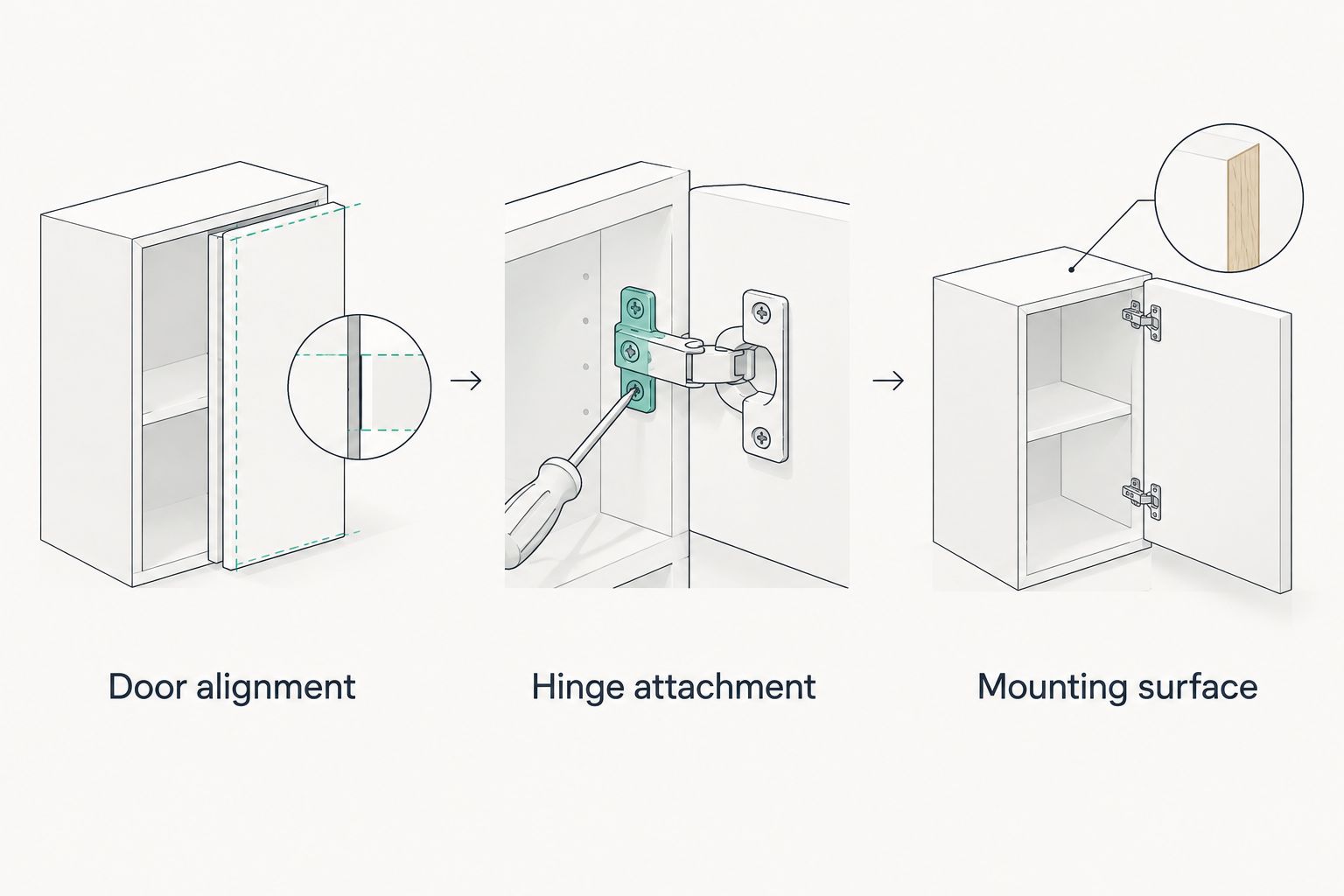
- Hinge attachment: Note whether the hinge separates from the door or cabinet side.
- Door alignment: Check whether the door rubs, sags, or leaves an uneven gap.
- Handle movement: Note whether the handle turns, rocks, or pulls away.
- Mounting surface: Look for crumbling material, enlarged holes, or visible cracks.
- Drawer movement: Describe catching or rubbing separately from loose pulls.
Try only straightforward tightening
The manual approach comes first: if an accessible fastening screw is visibly loose and the surrounding material is sound, use a hand screwdriver with the correct tip. Support the door while working and tighten gently. Stop if the screw spins without holding or the material begins to break apart.
Do not treat every hinge screw as a fastening screw. Some cabinet hinges have adjustment screws that change door position. Turning those at random can make alignment worse even when the hinge remains securely attached.
An appointment is the practical next step when the door needs support, the attachment is damaged, or you cannot identify the screw’s function. Avoid substituting a longer screw without checking the material thickness and what lies behind it.
- Match the screwdriver tip to the screw head before applying pressure.
- Use a hand tool for a controlled check rather than starting with a powered driver.
- Leave unfamiliar adjustment screws unchanged.
- Stop tightening when the screw no longer grips.
- Do not add glue, filler, or replacement fasteners before describing the damage.
Photograph the repair clearly
Photos help explain a cabinet problem without repeated descriptions. Take 3 photos per affected cabinet door: the full door closed, the hinge with the door open, and the damaged or moving attachment point. This is a preparation checklist, not a requirement for booking.
For a loose handle, add a view of the handle’s front and its accessible fasteners behind the panel. Keep the original hardware together if a part has already fallen off. Photograph it beside the cabinet rather than guessing its name.
A useful 2026 repair record shows the condition before anyone changes it. Avoid sending only an extreme close-up: the reader also needs to understand where the part sits and how the door behaves.
- Photograph the closed door to show gaps and alignment.
- Photograph the open hinge to show its attachment points.
- Photograph cracked material or an enlarged screw hole without altering it.
- Include any detached screw, mounting plate, or handle.
- Write a short symptom beside each photo, such as upper hinge pulling away.
Group related small repairs
Mr. Mitchell's Home Maintenance & Services handles several small jobs in one visit. Use that option to create a clear, realistic list rather than adding vague requests after the appointment begins. Cabinet hardware, door hardware, drywall repairs and painting, furniture assembly, and wall mounting fit the confirmed service categories.
For example, your list can contain 4 tasks: repair a loose cabinet hinge, secure a drawer pull, address a loose interior door handle, and inspect a wall patch that needs painting. Grouping organizes the visit; it does not establish a price, completion time, or promise that every task fits the appointment.
Put the unstable or unusable item first. Then identify which jobs need a discussion about materials, matching hardware, paint, or mounting location before work begins.
- List each repair separately, even when several are in the same room.
- Put a loose or unstable cabinet door ahead of cosmetic touch-ups.
- Add photos for door hardware, drywall damage, or mounting requests.
- Name any furniture awaiting assembly and keep its instructions available.
- Ask which listed jobs fit the appointment before assuming the full list is covered.
Confirm the repair scope and materials
A cabinet repair request should distinguish the desired result from the proposed method. Ask for a door that opens, closes, and stays securely attached; do not insist on replacing the hinge before its condition is assessed. The repair method depends on the attachment, hardware, and cabinet material.
Replacement hardware needs more than a similar appearance. Hinge type, mounting arrangement, handle spacing, and the door’s construction all matter. Keep packaging or identifying marks if you already have a replacement part, but confirm suitability before purchasing more.
For your 2026 appointment notes, separate repairs from finish work. Restoring a hinge attachment and touching up a visible surface are different tasks, even when they concern the same door.
- State whether you want existing hardware retained when practical.
- Mention cracked, swollen, or crumbling cabinet material.
- Ask whether replacement parts need identification before the visit.
- Keep existing screws and detached hardware together in a container.
- Identify any paint or finish touch-up as a separate request.
- Confirm the agreed work rather than assuming it includes full cabinet refinishing.
Clear access and check the finished repair
Prepare the work area without dismantling it. Move dishes, cleaning products, and stored items away from the affected hinge or drawer. Leave enough room for the door to open and for someone to inspect the attachment without reaching around crowded shelves.
After the repair, check 1 cabinet door at a time. Open and close it gently, watch the gaps, and test the handle without pulling sharply. A door that still catches needs attention before you load the cabinet again.
Check grouped repairs individually, too. A tightened handle and an aligned hinge are separate results; testing one does not verify the other.
- Empty the affected shelf or drawer enough to expose the hardware.
- Clear the floor directly in front of the cabinet.
- Keep detached parts and replacement packaging within reach.
- Point out adjacent surfaces you want protected during the work.
- Test opening, closing, and handle stability before restoring stored items.
Book your small repair appointment
Prepare cabinet photos and a list of small repairs to discuss for one visit.
Compare your cabinet repair options
Choose the option that matches the damage, not just the symptom. For a 2026 repair plan, an intact attachment with a loose screw calls for a different decision than cracked cabinet material or an unstable door.
| Option | Best for | Main advantage | Key limitation |
|---|---|---|---|
| Careful DIY tightening | A clearly identified loose fastening screw in sound material | Lets you address a straightforward fastening issue yourself | Does not repair stripped holes, cracked material, or broken hinges |
| Booked small-repair visit | Loose cabinet hardware alongside other household repairs | Lets you discuss several small jobs in one visit | The repair scope and any required parts need confirmation |
| Replacement-hardware request | A damaged hinge or handle that needs assessment for replacement | Focuses the visit on identifying and fitting suitable hardware | Similar-looking hardware is not necessarily compatible |
| Cabinet repair or replacement assessment | Extensive cabinet damage rather than an isolated loose fitting | Addresses the condition of the cabinet itself | Goes beyond a routine tightening task; confirm the appropriate service scope |
Choose a small-repair appointment when tightening no longer holds or the door needs more than an obvious fastening adjustment. An extensive cabinet problem deserves a separate scope discussion, not an assumption that a hardware visit includes rebuilding it.
Common mistakes NYC homeowners make
Tightening until the material gives way
A screw that keeps turning is not a signal to apply more force. It indicates that the connection is not gripping as expected. Continuing can enlarge the damaged area or make the screw harder to remove.
Stop, photograph the attachment, and describe what happened. That gives the repair professional useful information without adding another improvised fix to undo.
Buying a hinge based only on appearance
A matching finish does not establish a matching hinge. Cabinet door construction and mounting details affect fit, while handle replacements need compatible fastening positions.
Keep the old part and photograph how it was attached. Ask what information is needed before buying replacement hardware, particularly when the original hinge has no clear identification.
Describing every problem as a loose cabinet
That description hides the difference between a sagging door, a loose pull, a damaged hinge plate, and a drawer that catches. Each needs a different inspection.
Use a location and symptom: bathroom vanity, left door, upper hinge pulling away. For your 2026 checklist, keep those descriptions separate so the appointment discussion stays focused.
Adding jobs without preparing them
Grouping small repairs works best when the list is ready beforehand. A mounting request without the item or desired location, or furniture assembly without the instructions and parts, leaves questions unresolved.
Send or prepare the full list, then confirm what belongs in the visit. Grouping is a way to organize confirmed services, not a reason to assume every household task is included.
FAQ
Can I fix a loose cabinet hinge myself?
You can try gentle hand tightening when the fastening screw is clearly identified and the surrounding material is sound. Stop if the screw spins, the door is unstable, or you cannot distinguish fastening screws from adjustment screws.
Why does my cabinet hinge keep coming loose?
A hinge can keep coming loose when its fastener no longer grips, its mounting material is damaged, or the attachment needs repair. Inspect the connection rather than repeatedly tightening it without checking what moves.
Should I replace the hinge or repair the screw hole?
Choose the repair after identifying whether the hinge, its attachment, or the cabinet material is damaged. Replacing a sound hinge does not restore a damaged mounting point.
What should I prepare before booking cabinet hardware repairs?
Prepare photos of the closed door, open hinge, and affected attachment point, plus a short description of the problem. Keep detached hardware and any replacement packaging together, and clear access before the visit.
Can several small repairs be handled in one appointment?
Mr. Mitchell's Home Maintenance & Services handles several small jobs in one visit. Prepare requests for cabinet or door hardware, drywall repairs and painting, furniture assembly, or wall mounting, and confirm which tasks fit the appointment.
How much do home repair services for cabinet hinges cost?
The repair scope needs confirmation before you have a useful cost answer. Describe the affected hardware, damaged material, and any additional jobs, then ask for current pricing and what the quoted work includes.
Where can I book cabinet hardware repairs for my NYC home?
Mr. Mitchell's Home Maintenance & Services offers easy online appointment booking for home maintenance and repair services. Prepare your cabinet photos and grouped repair list before discussing the appointment for your Brooklyn or Queens home.
One last thing
Keep the old hardware until the repair is complete. A detached hinge plate, screw, or handle can help explain the original fitting even when you expect to replace it. Store those parts together, label the cabinet they came from, and bring out the container when the repair is discussed.
For your 2026 home maintenance plan, make the next move simple: photograph the problem, write down what moves, and prepare the other small jobs you want addressed. A clear list turns a general repair request into a useful appointment discussion.