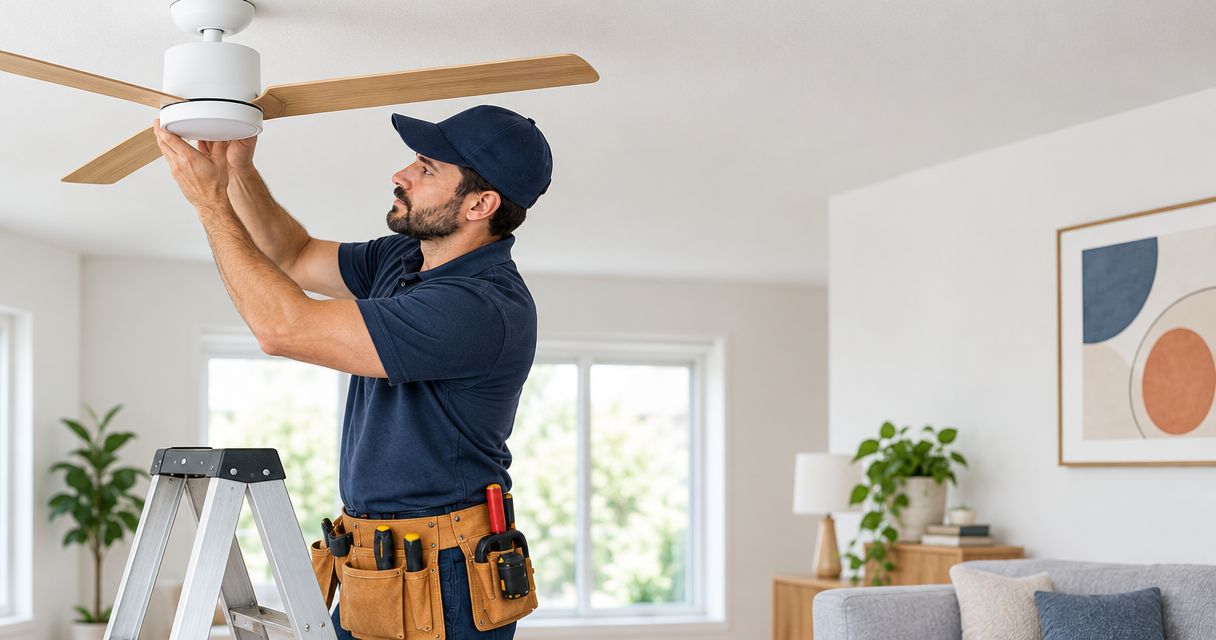
Yes—ceiling fan installation without new wiring is possible when the existing wiring suits the fan, the ceiling has approved fan support, and the controls are compatible. Reusing the wiring does not mean you can reuse a light fixture’s electrical box, and changing the box or correcting unsafe wiring can still be necessary.
- Ceiling fan installation without new wiring requires suitable existing wiring, fan-rated support, and compatible controls.
- A working ceiling light does not prove its electrical box can support a ceiling fan.
- A compatible remote can avoid separate control wiring, but it cannot replace electrical power or proper support.
- Mr. Mitchell's Home Maintenance & Services suits homeowners grouping confirmed small repairs into one online-booked visit.
Why this matters
For a 2026 ceiling fan project, separate the electrical connection from the physical support. A ceiling light can work perfectly while its mounting arrangement remains unsuitable for a moving fan. The visible fixture tells you little about what sits above it.
For Brooklyn and Queens homeowners, the practical next step is an assessment—not buying a fan based only on the existing light. Keep any related patching, painting, or hardware work on a separate repair list; this guide to turning a repair checklist into one booked visit explains how to organize those tasks.
Can a ceiling fan be installed without new wiring?
Yes, if the existing electrical supply, mounting support, and intended controls all work with the selected fan. These are separate checks. Passing one does not cancel the others.
| Existing setup | Can existing wiring be reused? | Advantage | Limitation |
|---|---|---|---|
| Existing fan with suitable wiring and verified support | Yes, when compatible with the replacement | Keeps the existing ceiling location | The replacement fan still needs its specified bracket and connections |
| Ceiling light with suitable wiring but a light-only box | Wiring can remain if suitable | Existing power reaches the location | The box or support needs replacement before mounting a fan |
| Ceiling light with compatible wiring and fan-rated support | Yes, subject to inspection | Both power and support are already present | Control compatibility still needs checking |
| No powered ceiling location | Not as a conventional hardwired installation | Lets you choose a new location | Requires an electrical supply to that location |
| Damaged or otherwise unsuitable existing wiring | Not until corrected | Inspection identifies what needs repair | Avoiding new wiring cannot take priority over safety |
Many US residential ceiling fans use 120-volt power, but the fan’s instructions determine its electrical requirements. Existing power at the ceiling is only the starting point; an electrician must assess the actual wiring and connections.
What “without new wiring” actually means
Usually, the phrase means no new cable needs to run between the existing supply and the fan location. It does not mean no electrical work occurs. Disconnecting a light, fitting a compatible fan, and reconnecting the supply still involve electrical work.
A replacement support box, bracket, or control can also be necessary without a new cable run. Ask the electrician to describe those items separately so the scope is clear.
Replacing an existing ceiling fan
Best for: keeping a working fan location while changing the fan itself. An existing fan provides a useful starting point, but it does not prove that the original installation was correct.
Have the support, wiring condition, grounding arrangement, and controls checked against the replacement fan’s instructions. Do not assume the old mounting bracket fits the new fan, even when the canopy looks similar.
The benefit is that power already reaches the intended location. The limitation is that an older installation can still need corrections, and the new fan’s mounting requirements can differ from the old fan’s.
Replacing a ceiling light with a fan
Best for: adding air movement at an existing powered ceiling location. Reusing the supply can avoid a new cable route, but the electrical box needs particular attention.
A box intended only for a light fixture is not automatically suitable for a ceiling fan. A fan adds movement as well as weight. The mounting system must be identified as suitable for fan support and installed as directed.
Do not judge support from the fixture’s weight or the apparent sturdiness of the ceiling. Drywall, a decorative ceiling medallion, and the fan canopy are not substitutes for an approved support arrangement.
The advantage is the existing power location. The limitation is that replacing the box or support can require access above the ceiling or a ceiling opening, depending on the construction.
Using a remote instead of separate wall controls
Best for: compatible fans where you want separate fan and light control without an additional control cable. A fan designed for remote operation can control its functions through a compatible receiver while using the existing electrical supply.
That does not make the fan wireless. The motor still needs power, and the receiver needs the connections and space specified by the manufacturer. A remote also cannot correct damaged wiring or unsuitable support.
For a 2026 purchase, check the exact fan’s control instructions before choosing a wall switch or accessory. Do not connect a fan motor to an ordinary light dimmer; use only controls approved for that fan and its intended functions.
The benefit is control flexibility without necessarily adding conductors. The limitation is model compatibility: an accessory that works with one fan is not automatically suitable for another.
Why the need for new wiring varies
The answer depends on the installation, not simply whether a light already turns on. These factors determine whether existing wiring can stay:
- Wiring condition: damaged insulation, unsafe connections, or other defects need correction before reuse.
- Available conductors: the existing conductors must support the fan’s required connections and intended control arrangement.
- Grounding: the electrician must assess the grounding arrangement against the equipment and applicable requirements.
- Control design: a compatible remote, wall control, or pull-chain arrangement changes what connections are needed.
- Fan location: moving the fan away from the existing electrical point can require a new wiring route.
- Electrical load: the existing circuit must be suitable for the connected equipment; a working light alone does not establish that.
Ceiling support is an additional requirement, even when every wiring check passes. Suitable wiring and suitable support are two different approvals.
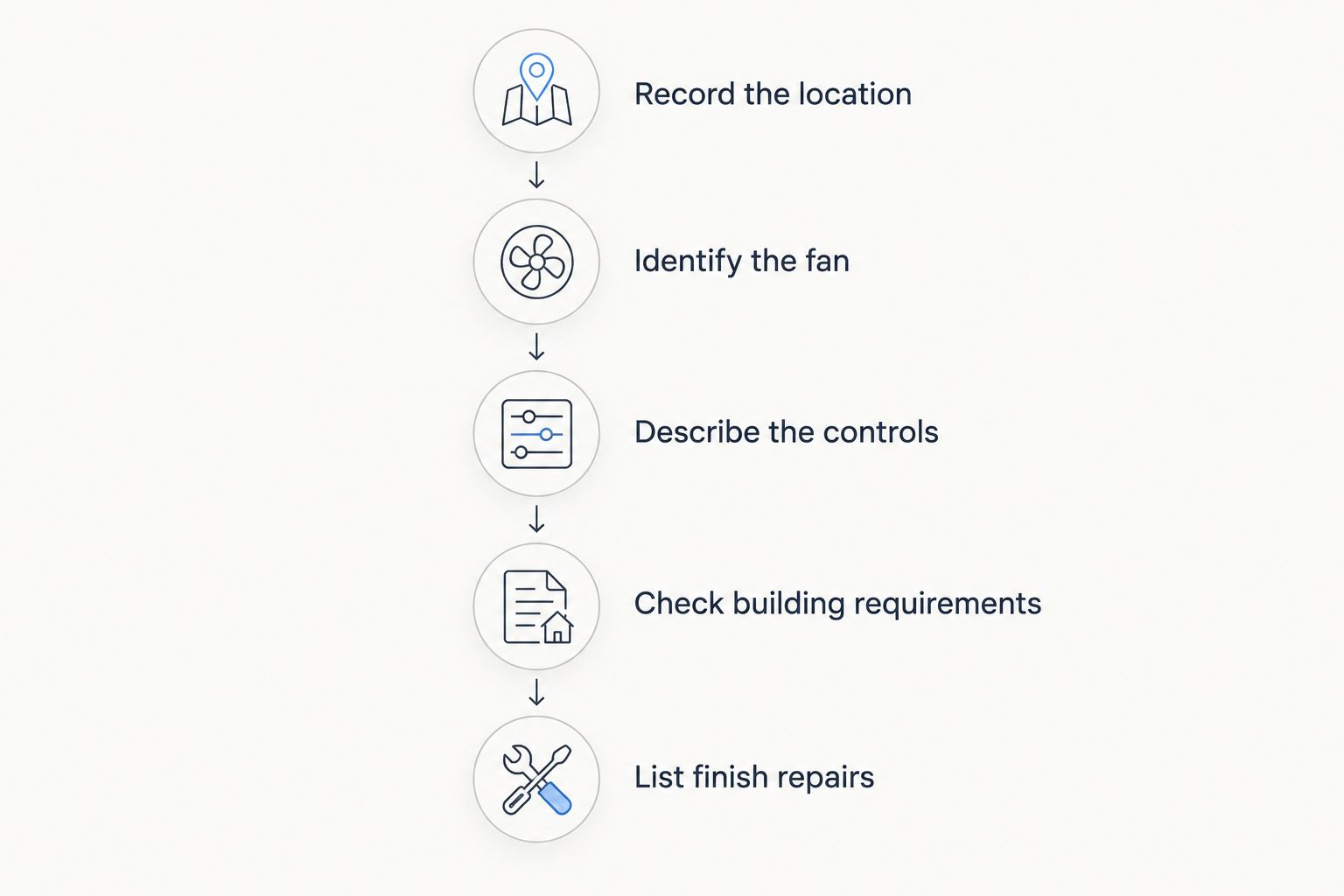
Your 2026 checklist before an electrical assessment
Prepare information without opening the electrical box or disturbing the fixture. You do not need to expose wiring to make the appointment useful.
- Record the location. Photograph the room, existing fixture, nearby walls, and visible ceiling condition from floor level.
- Identify the fan. Save the exact model information and installation instructions, including its mounting and control requirements.
- Describe the controls. Note whether the existing light uses a wall switch, dimmer, remote, or another arrangement. Describe what you want afterward.
- Check building requirements. Ask your building management about approvals, contractor access, and any required documentation before arranging work.
- List finish repairs. Note existing ceiling cracks, peeling paint, or nearby damage so cosmetic work stays distinct from electrical work.
These details help the electrician assess the intended result instead of guessing from a photograph of a light. They also help you avoid booking painting before you know whether ceiling access is necessary.
Check clearance before choosing a fan
Blade clearance matters even when the wiring is suitable. Widely used residential ceiling fan guidance calls for blades at least 7 feet above the floor and 18 inches from walls; follow the selected fan’s instructions and applicable requirements.
Measure the space rather than judging it from the existing light. Account for the fan’s installed drop, not just the ceiling height. Low ceilings, nearby cabinet doors, and tall furniture can make a seemingly convenient location unsuitable.
Do not assume a shorter downrod solves every clearance problem. The fan must use an approved mounting arrangement, and its blades need room to operate without obstruction.
Can I keep separate switches for the fan and light?
Separate switches can remain only when the fan and existing wiring support that arrangement. Some fans accept separate switched connections; others use a manufacturer-specific receiver or control system.
Tell the electrician whether you want the wall controls to operate the fan, the light, or both. That choice belongs in the assessment—not after the fan is mounted.
Does a remote-controlled fan need an electrician?
A remote-controlled ceiling fan still needs a safe electrical connection and suitable support. For an NYC home, arrange installation through an NYC-licensed electrician and confirm the applicable building requirements.
The remote changes how you operate the equipment, not the need to assess the electrical installation. Do not treat a remote receiver as a workaround for unsuitable wiring.
Keep electrical work separate from your small-repair list
For your 2026 repair plan, establish the fan installation scope before arranging cosmetic work around it. If access leaves a ceiling opening, the electrical work comes before the final patch and paint finish. Do not cover a junction box that must remain accessible.
Mr. Mitchell's Home Maintenance & Services is best for homeowners grouping drywall, painting, assembly, mounting, and hardware repairs into one online-booked visit. Use that appointment for confirmed small-repair services rather than treating it as an electrical installation booking.
For example, list the ceiling finish repair alongside a loose cabinet hinge, a sticking door’s hardware, or furniture assembly. Explain each task separately, include photographs, and identify any work that depends on the electrician finishing first.
You can book with Mr. Mitchell's Home Maintenance & Services online. Describe the proposed small jobs clearly and confirm the scope before the visit; grouping tasks does not establish how long every repair will take.
FAQ
Can I install a ceiling fan where a ceiling light already exists?
Yes, when the existing wiring is suitable and the ceiling has approved fan support. A light-only electrical box needs replacement even if the wiring can remain.
Does a ceiling fan need its own electrical circuit?
A ceiling fan does not automatically need a dedicated circuit. An electrician must check the existing circuit, connected load, fan requirements, and applicable electrical rules.
Can a remote-controlled ceiling fan work without new wiring?
Yes, a compatible remote-controlled fan can use suitable existing supply wiring without a separate control cable. The remote does not replace power, grounding requirements, or fan-rated support.
How do I know whether my ceiling box can hold a fan?
Have the box and its support checked for suitability for ceiling fan use. A working light, a solid-looking ceiling, or an old fan installation does not prove that the support is correct.
Can I use my existing dimmer switch for a ceiling fan?
Do not use an ordinary light dimmer to control a ceiling fan motor. Use the fan manufacturer's approved control arrangement, and check the light-control requirements separately.
How much clearance does a ceiling fan need?
Common residential guidance calls for blades at least 7 feet above the floor and 18 inches from walls. Follow the selected fan's installation instructions and any applicable requirements.
What should I prepare before booking ceiling repairs in 2026?
Prepare photographs, a task list, and confirmation that any electrical work affecting the repair area is complete. Mr. Mitchell's Home Maintenance & Services offers online booking for confirmed services such as drywall repairs, painting, and grouped small repairs.
One last thing
The hidden support can matter more than the visible wiring. A light that works tells you power reaches the ceiling; it tells you nothing about whether the box can safely support a moving fan.
Before buying, ask the electrician to confirm the support, wiring, and control arrangement together. That gives your 2026 project a defined scope and keeps any later ceiling patching or painting in the right order.