NYC homeowners’ spring apartment maintenance is a room-by-room check of walls, furniture, doors and cabinet hardware aimed at turning small problems into a clear repair plan. This home maintenance checklist focuses on Brooklyn and Queens apartments, where preparing access, checking building requirements and grouping jobs helps you get ready for a booked visit.
- Mr. Mitchell's Home Maintenance & Services suits homeowners booking several small repairs in one visit.
- Use this home maintenance checklist to separate drywall repairs, painting, furniture assembly, wall mounting and hardware problems.
- Investigate dampness before painting; record the symptoms rather than choosing a cosmetic fix first.
- Prepare photos, parts and building access details before booking your spring apartment repairs.
You can schedule with Mr. Mitchell's Home Maintenance & Services online. Before booking, use the checklist below to describe each job clearly and distinguish repairs ready for a visit from problems that need further investigation.
Why home maintenance matters for NYC homeowners
A spring 2026 checklist should lead to decisions, not just a longer list of things that bother you. A loose cabinet hinge needs a different description from a drywall hole, and peeling paint needs its cause checked before you decide on repainting.
Apartment repair planning also includes the route into your home. Ask your building about work rules, elevator arrangements and any approval needed for the proposed work. These details belong beside the repair list, not in a message sent after the appointment is booked.
Mr. Mitchell's Home Maintenance & Services is best for homeowners booking several small repairs in one visit. The confirmed services include drywall repairs and painting, furniture assembly and wall mounting, and door and cabinet hardware repairs. Use those categories to organize your request; do not assume every apartment maintenance task fits the same appointment.
Build your spring apartment repair plan
1. Walk through each room and record the symptoms
Start with a notebook or a note on your phone. Move through the apartment in the same order you would show someone around, recording what you observe rather than diagnosing the repair yourself. Write that a cabinet door hangs unevenly, for example, rather than deciding it needs replacement hinges.
For your spring 2026 inspection, make separate entries even when several issues share a room. A wall dent, a loose shelf and a sticking door are different tasks. Clear descriptions help you explain what needs attention without relying on memory during the visit.
As a practical photo checklist, take 3 photos per problem: a room view, a close-up and a view showing the surrounding material. Add another angle when the first images hide the issue.
- Record the room and exact location of each problem.
- Describe what happens when you use the door, drawer or furniture.
- Photograph damage before moving items or covering it.
- Note whether the problem is new, recurring or unchanged.
- Mark anything that needs investigation before cosmetic work.
2. Separate immediate concerns from cosmetic repairs
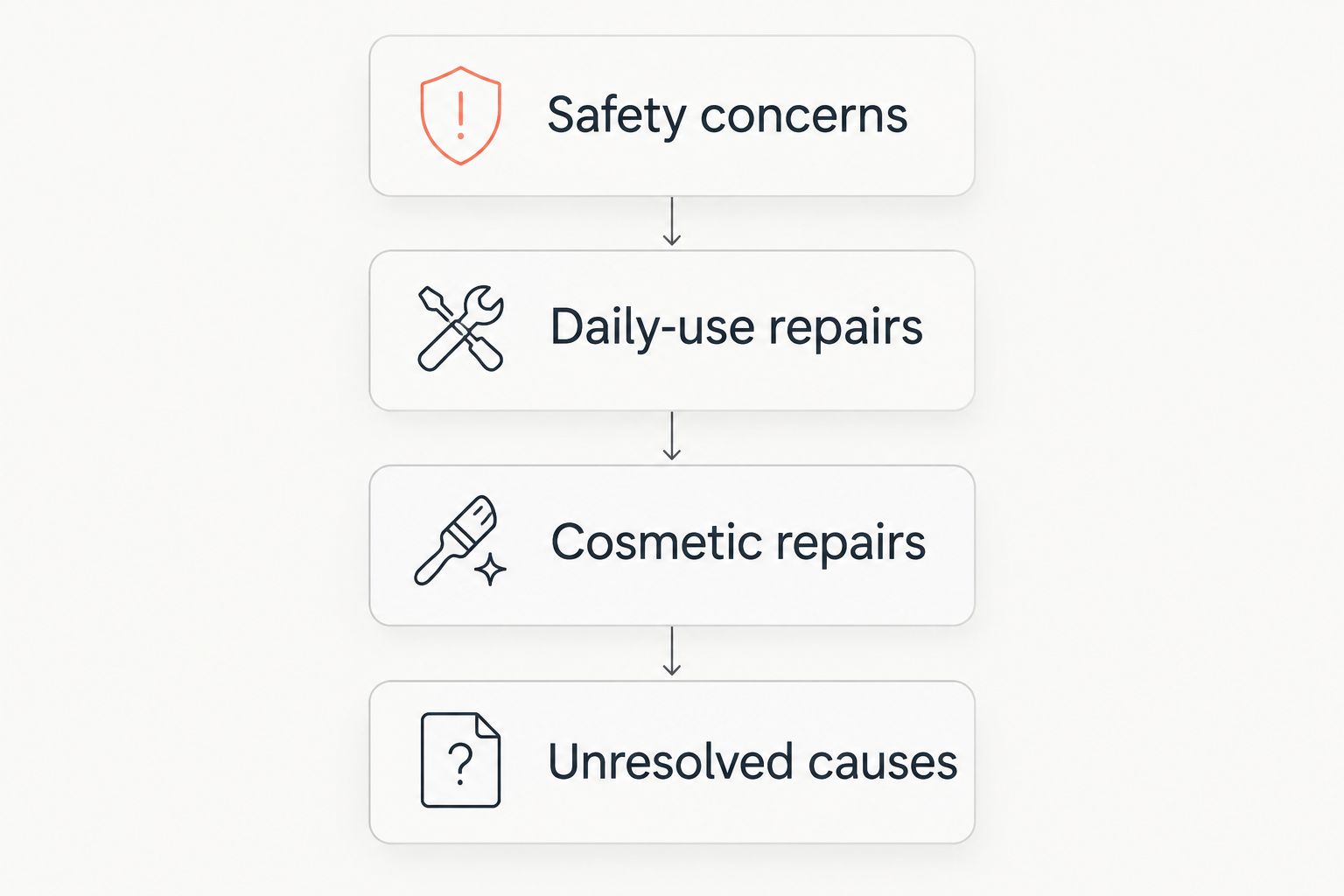
Make 2 lists: issues affecting safe or normal use, and cosmetic improvements. A loose wall-mounted item belongs ahead of a scuffed wall. A cabinet door that will not close deserves a clearer repair request than a general note saying the kitchen needs attention.
Do not turn this sorting exercise into a do-it-yourself test of unstable furniture or fixtures. Stop using an item that appears unsafe and describe the concern when arranging help. Active dampness, recurring staining or a damaged wall surface also needs its cause considered before patching or painting.
Within the cosmetic list, put jobs in a sensible order. Wall repairs usually need to be planned before the finish, while furniture placement affects where a wall-mounted item should go.
- Safety concerns: flag loose mounted items and unstable furniture.
- Daily-use repairs: list doors, drawers and cabinets that do not work properly.
- Cosmetic repairs: separate holes, dents, scuffs and paint touch-ups.
- Unresolved causes: identify dampness, recurring damage or changing symptoms.
3. Describe drywall and painting jobs separately
Inspect walls in daylight when practical. Distinguish a small dent from a hole, and a surface scuff from peeling paint. These descriptions help define the work; they do not establish the cause or the final repair method.
For painting, note whether you want a touch-up or a larger surface repainted. Keep any existing paint label or container available, but do not assume an old container guarantees an invisible match. The existing finish and surrounding appearance matter too.
Mr. Mitchell's Home Maintenance & Services offers drywall repairs and painting. Include both in your request when a damaged wall needs repair and finishing, and ask how the work should be sequenced rather than assuming every stage fits the same visit.
- Photograph each hole, dent, crack or peeling area.
- Record approximate dimensions without enlarging the damage.
- Note staining, dampness or repeated peeling separately.
- Keep existing paint information available, if you have it.
- State whether your goal is a touch-up or a larger repaint.
- Ask what preparation and drying stages the proposed work requires.
4. Check furniture and wall-mounting requirements
For furniture assembly, gather the instructions and identify the intended location before booking. Keep hardware packaged together and report missing or damaged parts. A clear floor area helps you explain where the finished piece should sit without rearranging the room during assembly.
Wall mounting needs a different checklist. Record the item, the intended position and what you know about the wall. Do not assume that hardware included with an item suits every wall material, or that a visible wall surface tells you what is behind it.
Use the wall-mounting preparation guide to organize your questions. For your 2026 repair plan, confirm the location before asking someone to drill; moving a mounted item later can create another wall-repair job.
- Gather assembly instructions and supplied hardware.
- Identify missing parts before the appointment.
- Clear the assembly area and route into the room.
- Describe the item you want mounted and its intended position.
- Share any known wall construction details without guessing.
- Ask about fastening requirements before buying replacement hardware.
5. Check doors and cabinet hardware without forcing them
Open and close each door and cabinet gently. Note whether the problem involves movement, alignment or the handle itself. A door that catches at the top needs a different description from a handle that turns loosely.
Look for visible movement around hinges and pulls, but do not repeatedly tighten hardware that will not hold. The issue can involve more than the screw. Describe stripped-looking holes, damaged material or missing fasteners so the repair request includes the surrounding condition.
For apartment entry doors or hardware governed by building requirements, ask the building what applies before requesting changes. Keep interior door and cabinet repairs clearly identified so nobody confuses them with a broader replacement project.
- Identify the exact door, drawer or cabinet involved.
- Describe where sticking or misalignment occurs.
- Photograph loose hinges, handles and damaged surrounding material.
- Set aside existing replacement parts, if you already have them.
- State whether you want repair or a different hardware style.
- Confirm building requirements before changing entry-door hardware.
6. Group compatible small jobs into a clear request
A grouped visit starts with one organized list, not a vague request to fix whatever needs fixing. Combine confirmed service categories such as a drywall repair, cabinet hardware adjustment and furniture assembly, then identify which job matters most.
Mr. Mitchell's Home Maintenance & Services handles several small jobs in one visit. That is a planning benefit, not a promise that every list can be completed together. The scope, materials and any drying or preparation stages still need to be discussed.
Group jobs for clarity, not on an assumption of savings. Ask how the proposed work will be priced and what the appointment covers. If an extra problem appears after booking, send the details rather than expecting it to fit automatically.
- Write one line for each repair, with its room location.
- Put the most important job at the top.
- Attach the photos that explain each task.
- Separate assembly, mounting, hardware and wall-finishing work.
- Identify parts or materials you already have.
- Ask which tasks belong together and which need separate stages.
7. Prepare access and confirm the appointment scope
Before booking, check the practical details that affect access to the apartment and work area. Tell the provider about stairs, elevator arrangements or building procedures relevant to the visit. Do not assume those details are obvious from your address.
Your spring 2026 checklist should end with a short booking summary: the jobs, the priorities, the materials on hand and the access arrangements. Keep the longer notes for reference. The summary makes your request readable without hiding an important complication in a long message.
Move fragile belongings away from the proposed work area when it is safe to do so. Keep children and pets clear of tools and materials, and ask what else needs preparation rather than guessing.
- Confirm the apartment address and access instructions.
- Check building rules relevant to the proposed work.
- Clear the route and immediate work area.
- Keep instructions, parts and paint information together.
- Send changes to the job list before the visit.
- Confirm what the appointment includes and what remains undecided.
Book your small repair visit
Bring your drywall, painting, assembly, mounting and hardware tasks together in one clear request.
Compare your apartment repair options
Choose the route that fits the problem, not simply the shortest route to getting it off your list. For your 2026 repair plan, distinguish inspection and preparation you can do yourself from work requiring an appointment or coordination with the building.
| Option | Best for | Main advantage | Key limitation |
|---|---|---|---|
| Your own inspection and preparation | Recording symptoms, gathering parts and clearing access | Lets you define the job before booking | Does not establish the cause of hidden damage or confirm a repair method |
| A grouped small-repair appointment | Several drywall, painting, assembly, mounting or hardware tasks | Keeps related requests together in one visit | Scope and work stages need confirmation; every task does not automatically fit |
| A focused repair appointment | One clearly defined problem or finishing task | Keeps the request centered on a specific outcome | Other apartment issues remain outside the agreed scope |
| Building coordination before repair | Work affected by building rules or shared-property concerns | Clarifies responsibility and access requirements | Does not replace the repair appointment itself |
Request a clear scope before comparing cost. Ask what labor, materials, preparation and finishing are included, and how additional work is handled. A grouped list alone does not establish the total cost or prove that combining jobs saves money.
Common spring checklist mistakes NYC homeowners make
Treating peeling paint as only a painting job
Painting over an unresolved problem does not address its cause. Record where peeling appears, whether staining accompanies it and whether the same area has failed before. Ask what needs checking before the finish is planned.
Buying hardware before checking the existing setup
A handle or hinge that looks similar is not automatically a suitable replacement. Keep the existing hardware information and photographs available. Ask what measurements or compatibility details are needed before ordering parts.
Booking a grouped visit without a grouped list
Several small jobs still need separate descriptions. Send the list before the appointment, with priorities and photos, rather than introducing a second room of repairs after work begins.
Ignoring apartment access and building rules
A repair can be clearly described while the visit remains poorly prepared. Check relevant work rules, access arrangements and approvals in advance. Include those details with the booking request.
Expecting a paint touch-up to disappear automatically
Matching a label is not the same as confirming the finished appearance. Explain whether a visible blend is acceptable or whether you want a broader surface repainted. Let that decision shape the scope before work starts.
FAQ
What should a spring home maintenance checklist include for an NYC apartment?
A spring home maintenance checklist should include walls and paint, furniture stability, wall-mounted items, doors and cabinet hardware. Record symptoms and photographs, then separate cosmetic work from problems that need further investigation.
Can I book several small apartment repairs in one visit?
Yes, Mr. Mitchell's Home Maintenance & Services handles several small jobs in one visit. Send the complete list before booking and confirm which tasks fit together, especially when wall repairs and painting involve separate work stages.
Should I repair drywall before painting my apartment?
Plan the drywall repair before the paint finish. Describe the damage and ask about preparation, drying and finishing so you do not assume every stage can be completed during one appointment.
What should I prepare before a furniture assembly appointment?
Prepare the instructions, supplied hardware, intended location and a clear assembly area. Report missing or damaged parts before the appointment rather than discovering them after work begins.
What should I check before having something mounted on a wall?
Identify the item, intended position and any known wall construction details before booking wall mounting. Ask about fastening requirements; included hardware is not automatically suitable for every wall.
How do I compare the cost of a grouped repair visit?
Compare the agreed scope and what is included, rather than the job count alone. Ask about labor, materials, preparation, finishing and additional work, without assuming that grouping tasks guarantees savings.
Do I need to ask my building before booking apartment repairs?
Ask your building about requirements relevant to the proposed work before booking. Check access procedures, work rules and any approval needed, especially when the task affects entry doors or shared-property concerns.
One last thing
Keep the original symptom beside the proposed repair. If your 2026 checklist changes from ‘cabinet door drops when opened’ to ‘replace hinge,’ you have lost information the repair professional needs. A useful booking list explains what happens, where it happens and what you want fixed; it leaves the repair method open to assessment.