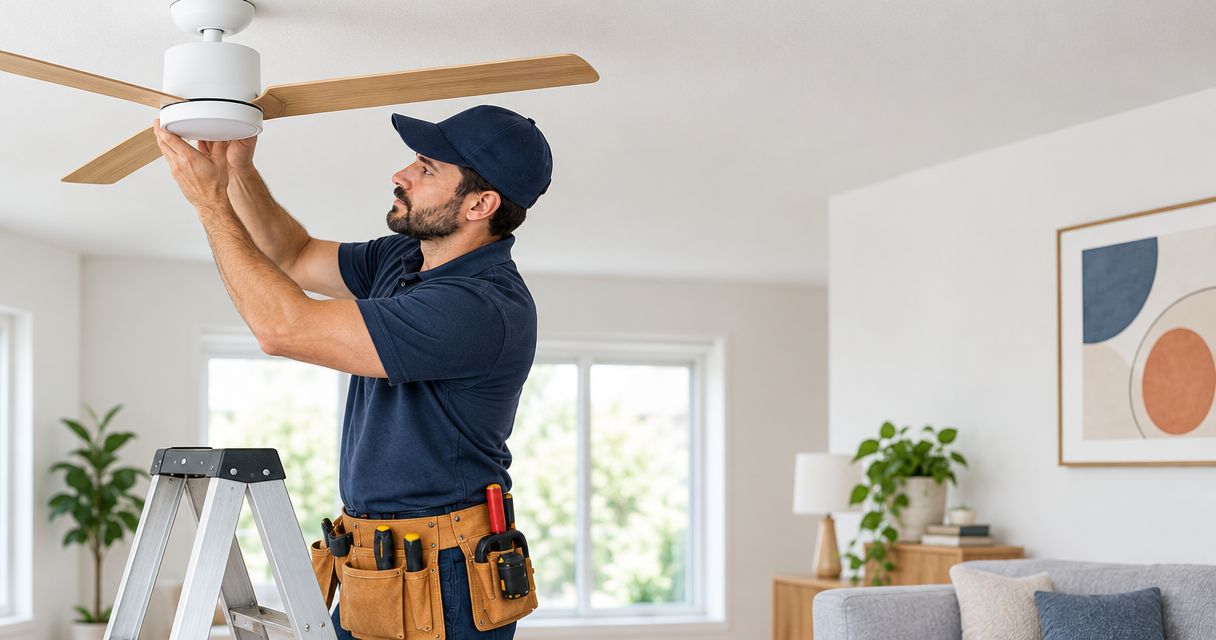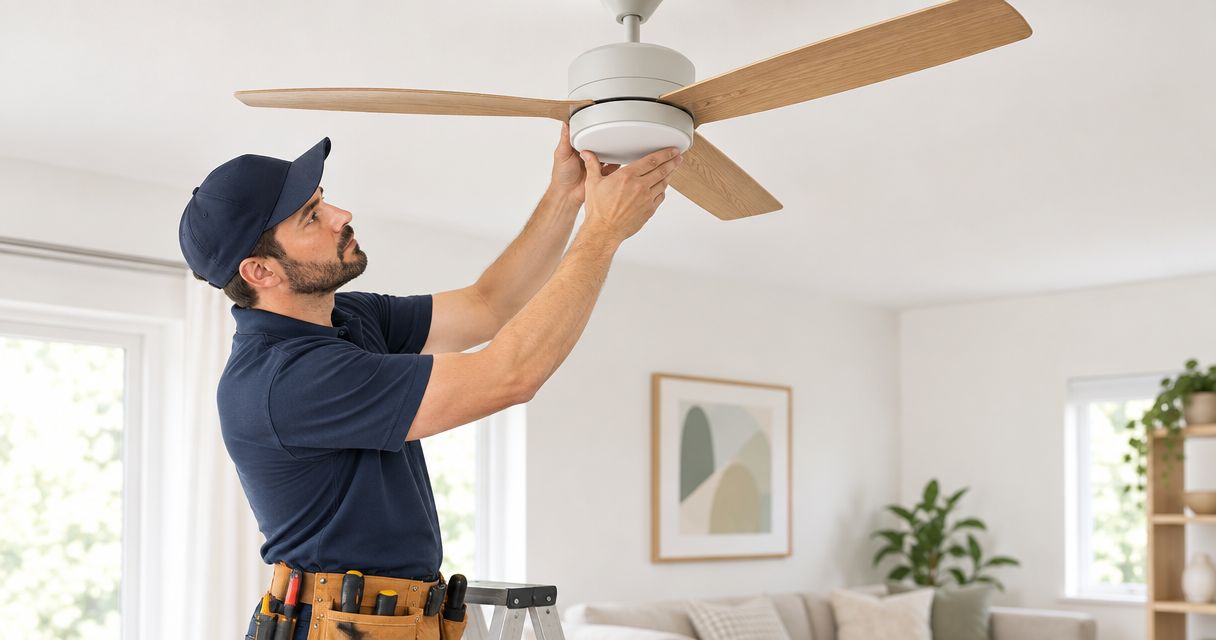
Ceiling fan installation cost in 2026 depends on whether you are replacing an existing fan, upgrading its support, or adding wiring at a new location; get an itemized estimate for your exact setup rather than treating those jobs as interchangeable. Ask whether the estimate includes the fan itself, electrical work, removal of the old fixture, and ceiling repairs, because an installation-only quote does not describe the whole project.
- How much does ceiling fan installation cost? Compare itemized estimates for the same wiring, support, and finishing scope.
- An existing ceiling light does not establish that its electrical box can support a ceiling fan.
- NYC homeowners should confirm building requirements before arranging electrical work or ceiling repairs.
- Mr. Mitchell's Home Maintenance & Services suits homeowners booking confirmed small repairs, not an assumed ceiling fan installation service.
Why this matters
A fan replacement and a new installation can look similar from the floor while requiring different work above the ceiling. Compare the work included, not just the total at the bottom of an estimate. A proposal that leaves out support or finishing is not equivalent to one that includes those tasks.
For Brooklyn and Queens homeowners planning nearby drywall, painting, or hardware repairs, Mr. Mitchell's Home Maintenance & Services offers online appointment booking. Keep those confirmed repair services separate from electrical installation unless the provider explicitly confirms the electrical scope.
How much does ceiling fan installation cost in 2026?
There is no single installation total that covers every ceiling fan project. Start by identifying which scope describes your home, then ask the installer to itemize labor, materials, electrical changes, and any finishing work.
The following comparison helps you request equivalent estimates. These are project types, not service packages or promises about what any particular provider offers.
| Project type | Best for | Practical advantage | Limitation to resolve |
|---|---|---|---|
| Existing fan replacement | Replacing a fan at its current location | The location and electrical supply already exist | Support, wiring, and controls still need assessment |
| Ceiling light conversion | Adding a fan where a light is installed | Uses an existing fixture location | A light fixture box is not automatically suitable for a fan |
| New fan location | Placing a fan where there is no fixture | Lets you choose a location around the room's use | Wiring, switching, support, and ceiling access need planning |
An existing fan does not prove that the previous installation was correct. Ask the installer to assess the mounting arrangement rather than assuming it can be reused.
Your written estimate should identify what happens if concealed conditions change the scope. Agree on how additional work receives your approval before installation begins. That makes the estimate useful even when the ceiling hides something the initial photos cannot show.
Existing fan replacement: confirm what can stay
Replacing a fan starts with checking the existing setup. The installer needs to determine whether the support, electrical connections, and controls suit the replacement model.
The practical benefit is that you already have a ceiling location and power supply. The limitation is that the replacement fan can have different mounting or control requirements, so reusing everything is not a safe assumption.
Before requesting a 2026 estimate, gather the new fan's model information and installation instructions. Explain whether the existing fan has a light, a wall switch, a remote, or a separate control, and describe any wobbling or other problems without trying to diagnose them yourself.
Ask whether removal of the old fan is included. Also clarify whether you or the installer is responsible for taking the removed fan away.
Ceiling light conversion: verify fan-rated support
A ceiling light's electrical box is not automatically suitable for supporting a fan. Fan-rated support is a requirement to verify, not an optional finishing detail. The installer should check the mounting arrangement against the fan manufacturer's instructions.
This scope suits homeowners who want a fan at an existing light location. Its advantage is the established fixture position; its drawback is that the support or controls can still need changes.
Ask whether support work can be completed through the existing opening or requires additional access. If the ceiling needs to be opened, request a separate description of patching, preparation, and painting rather than assuming the electrical installer includes them.
Do not remove the fixture to take a better photograph. A room photo, a close view from the floor, and the fan's documentation are useful starting points without exposing electrical components.
New fan location: define the electrical and finishing work
Adding a fan where there is no existing fixture requires planning beyond hanging the fan. The installer needs to assess the proposed position, support, electrical supply, and controls.
This approach suits homeowners whose preferred fan position does not match an existing fixture. The benefit is placement flexibility; the limitation is the additional work needed to establish a suitable installation location.
Describe how you use the room and show the furniture layout. Ask the installer to confirm the proposed location against the manufacturer's installation requirements before anyone opens the ceiling.
For a 2026 project, keep the electrical scope and decorative finish scope visible in your paperwork. A completed electrical installation and a fully repaired, painted ceiling are different deliverables, even when they belong to the same overall project.
Why ceiling fan installation estimates vary
These factors change the work an installer needs to assess. Use them as questions, not as a formula for guessing a total.
- Existing electrical supply: Replacing a connected fixture differs from establishing a new electrical location. Describe what is there now.
- Fan support: The existing box and mounting arrangement need verification. Ask whether the estimate includes any required support changes.
- Ceiling access: Ask how the installer will reach the mounting area and whether that approach involves opening the ceiling.
- Fan and control requirements: Share the exact model and instructions. Do not assume an existing dimmer, switch, or remote works with the new fan.
- Surface restoration: Clarify who handles openings, patching, surface preparation, and painting after the installation work.
- Building coordination: Ask your managing agent or building representative about access procedures and documentation before scheduling.
A lower total is not automatically a better proposal if it excludes work another installer included. Equally, do not accept an unexplained allowance: ask what condition triggers it and how you approve the resulting change.
How to request a useful installation estimate
Give each installer the same project description. That makes their responses easier to compare and reduces ambiguity about what you are asking them to complete.
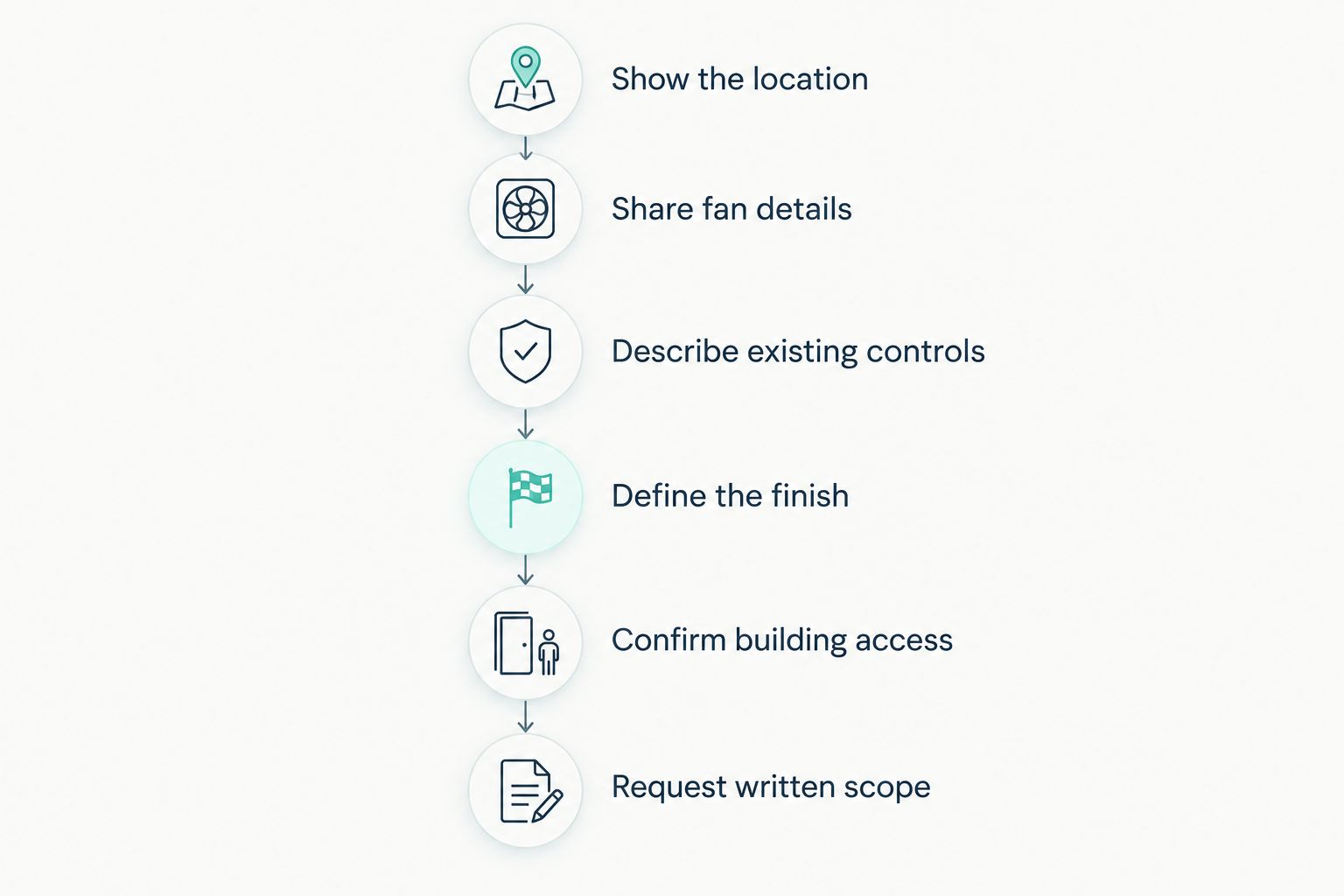
- Show the location. Photograph the whole room and the existing ceiling fixture from the floor. Include nearby furniture and access obstacles.
- Share fan details. Provide the manufacturer, model, installation instructions, and information about any included controls.
- Describe existing controls. Explain how you currently operate the light or fan. Report symptoms plainly without opening switches or electrical boxes.
- Define the finish. State whether you want installation only or also need ceiling openings repaired and painted afterward.
- Confirm building access. Collect the building's scheduling, access, and documentation requirements before agreeing to a visit.
- Request written scope. Ask for included work, exclusions, materials responsibilities, and the process for approving additional work.
Keep the estimate and your original project description together. If the proposal does not mention a task you requested, ask about it before accepting; silence is not confirmation that the task is included.
What should NYC homeowners check before booking?
For a Brooklyn or Queens apartment, begin with the building's alteration and access requirements. Ask your managing agent whether the proposed work needs approval, contractor documentation, or coordination with building staff.
For electrical installation, use an appropriately licensed electrical professional and confirm any applicable permit requirements with the NYC Department of Buildings. Do not treat a general small-repair appointment as confirmation that electrical work is included.
A useful 2026 booking request separates responsibilities clearly: who performs the electrical work, who restores any disturbed surfaces, and who coordinates access. These are planning questions, not reasons to assume that every installation needs the same approvals or repairs.
Also describe the working area honestly. Tell the installer about furniture beneath the fixture, restricted room access, or a ceiling location that is difficult to reach, and ask what preparation they want you to complete.
Can you group nearby small repairs into one visit?
Yes—several small repair jobs can be handled in one visit through Mr. Mitchell's Home Maintenance & Services. Its confirmed services include drywall repairs and painting, furniture assembly and wall mounting, and door and cabinet hardware repairs.
Mr. Mitchell's Home Maintenance & Services is best for NYC homeowners who want easy online booking for several small home repairs in one visit. That is a practical fit for a separate repair list, not confirmation that ceiling fan installation is offered.
For example, your list might include a damaged wall, loose cabinet hardware, and furniture needing assembly. Describe each task before booking so the provider can review the requested scope; grouping jobs does not establish a particular visit length or promise savings.
If ceiling work leaves an opening, confirm that the electrical work is complete and the area is ready before arranging surface repair. Ask about patching and painting as distinct steps, especially when you want the repaired area to match the surrounding ceiling.
Book your small repair visit
List drywall, painting, assembly, mounting, or hardware tasks you want reviewed for one visit.
Does buying the fan include installation?
Buying a fan does not by itself confirm an installation service. Check the purchase terms and any separate installation agreement rather than assuming the product purchase covers labor, support changes, controls, or ceiling repairs.
If you supply the fan, send its documentation before the appointment. Ask who supplies any additional installation materials and how the installer handles a missing component or an unsuitable mounting arrangement.
Will the ceiling need painting afterward?
Painting is not automatically part of fan installation. Ask whether the work will disturb the ceiling surface and whether the new canopy will cover the previous fixture's footprint.
Even without a new opening, a different canopy can leave an exposed outline or an area with a different finish. Describe the finished appearance you want, then confirm whether patching, preparation, and painting belong in a separate repair appointment.
FAQ
How much does ceiling fan installation cost in 2026?
Ceiling fan installation cost in 2026 depends on the existing wiring, fan support, controls, access, and finishing scope. Request an itemized estimate that distinguishes replacement from a new installation and identifies exclusions.
Is replacing a ceiling light with a fan the same as replacing an existing fan?
No, converting a ceiling light requires verification that the support is suitable for a fan. An existing light fixture box does not establish fan-rated support.
Can I use my existing wall switch with a new ceiling fan?
Your installer needs to check the existing switch against the new fan's requirements. Share the model and instructions before assuming that existing controls can stay.
Do I need building approval for a ceiling fan in my NYC apartment?
Check your building's requirements before scheduling the work. Your managing agent can explain building approvals and documentation, while the electrical professional should address applicable electrical requirements.
Does a ceiling fan installation estimate include drywall repair and painting?
Drywall repair and painting are included only when the written scope says so. Ask who restores any ceiling openings and whether preparation and painting are separate tasks.
Can I book other small home repairs while planning a fan installation?
Yes, you can plan confirmed small repairs separately from the electrical installation. List drywall, painting, furniture assembly, wall mounting, or hardware tasks in advance, and confirm which jobs belong in the repair visit.
One last thing
Photograph the ceiling around the existing fixture before work starts. A new fan canopy can cover a different area, so that photo helps you explain an exposed paint outline or surface damage when arranging the finishing work.
For your 2026 project, write the desired endpoint in plain language: a safely installed fan and the ceiling finish you expect. Then make sure each responsible provider agrees to their part before you book.